Meet the Barbs: Tiger, Cherry & Rosy Barb - Which One Is Right for Your Tank?
In This Guide
- 1. Same Family, Very Different Fish
- 2. Meet the Barbs
- 3. Space and the Starter Kit
- 4. The Filter
- 5. The Heater
- 6. The Lid
- 7. Plants and Environment
- 8. An Invisible Science: the Nitrogen Cycle
- 9. Choosing Tank Mates
- 10. Feeding
- 11. The Weekly Rhythm
- 12. Which One Is Right for You?
- 13. Quick Reference: Barbs at a Glance
- 14. Myths: Fact vs. Fiction
A school of tiger barbs never sits still. They race the length of the tank in a striped blur, squabble, regroup and race again. In the next tank over, a pair of cherry barbs drifts between the plants, the male glowing a deep, glossy red. Further along, a group of rosy barbs flashes pink and gold in the light.
All three are barbs. All three are hardy, colourful and easy to find. And they make three completely different tanks.
That's where most barb problems start. Someone picks the one that catches their eye, drops it into whatever tank they have, and a few weeks later the angelfish has ragged fins or the cherry barbs are hiding behind the filter. Choose the barb that suits your tank, and you'll have one of the liveliest fish in the hobby.
Same Family, Very Different Fish
Barbs get lumped together as "fin nippers". That label is really about the tiger barb, and even then mostly about tiger barbs kept in groups that are too small. The cherry barb is one of the gentlest fish you can buy. The rosy barb sits in between, and it has a trick the other two don't: it's happy in cooler water.
Meet the Barbs
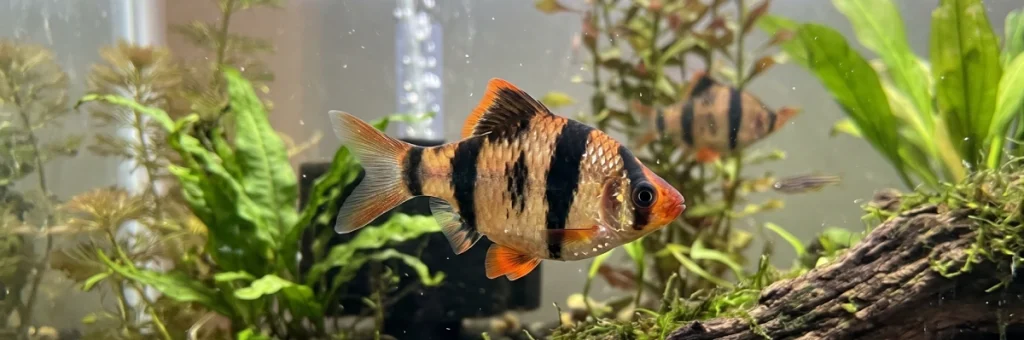
The Tiger Barb (Puntigrus tetrazona) is the class clown. Gold with four bold black bands and red-tipped fins, it comes from Sumatra and Borneo, grows to about 6–7cm and lives 5–7 years. It's busy, playful and always looking for something to do. Bored tiger barbs find that something in other fishes' fins.
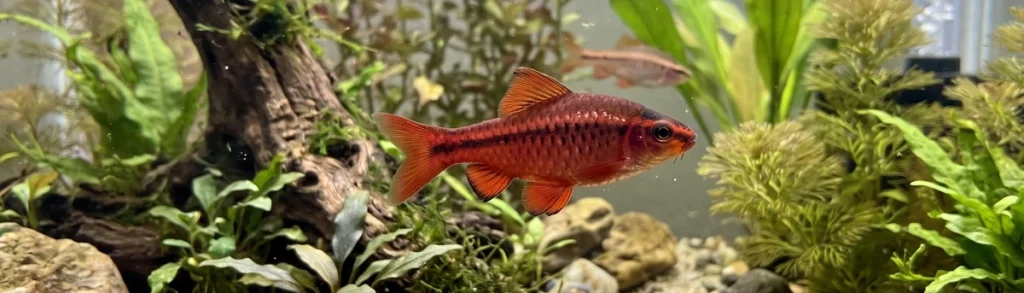
The Cherry Barb (Puntius titteya) is the quiet one. A small fish from the shaded streams of Sri Lanka, it reaches about 5cm and lives around 5–7 years. Females are soft brown-gold; males turn a rich cherry red as they mature, especially when there are females around to impress.
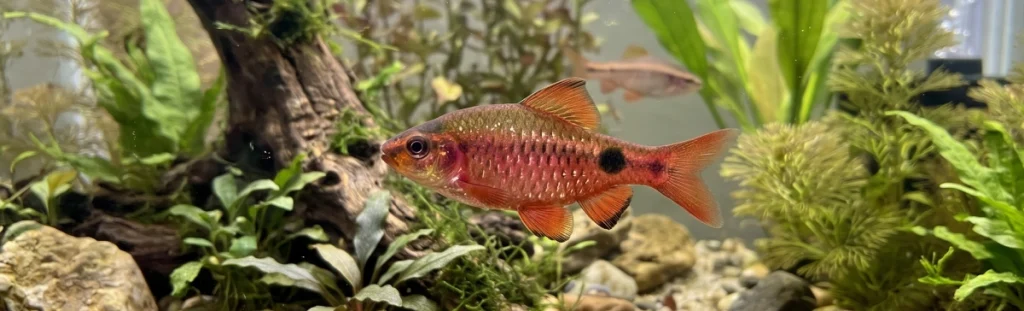
The Rosy Barb (Pethia conchonius) is the hardy one. From northern India and Bangladesh, it grows larger, to about 10cm in the aquarium, and lives five years or more. Males blush deep pink-red, females stay gold, and both tolerate cooler water than most tropical fish.
| Barb | Adult size | Temperament | Group size | Temperature |
|---|---|---|---|---|
| Tiger | 6–7cm | Boisterous, nips in small groups | 8 minimum, 10+ better | 22–26°C |
| Cherry | About 5cm | Peaceful and shy | 6+, more females than males | 23–27°C |
| Rosy | About 10cm | Active, mostly peaceful | 6+ | 18–24°C |
You'll find all three in our Barbs range.
Space and the Starter Kit
All three are schooling fish, and schools need swimming room. Long tanks beat tall ones every time.
Our experts recommend 60 litres for a group of cherry barbs, 90–100 litres for a proper school of tiger barbs, and 100 litres or more for rosy barbs, which are bigger and faster than they look in the shop.
Buy your gear at least two weeks before your fish.
The Filter
Barbs come from flowing streams and like clean, well-oxygenated water. A hang-on-back or canister filter rated for your tank works well for tiger and rosy barbs. Cherry barbs come from slower, shaded water, so baffle the outlet or choose a gentler filter for them.
The Heater
Tiger and cherry barbs are tropical and need a heater set to around 24–25°C, especially through a southern winter. Rosy barbs are the exception. They're comfortable at 18–24°C, so in a heated home they often need little help. A heater set to about 20°C still makes a sensible safety net when Melbourne or Canberra nights turn cold.
The Lid
Rosy and tiger barbs are fast and can jump when startled. Fit a lid from day one.
Plants and Environment
Cherry barbs are the ones that truly need plants. In the wild they live under overhanging forest in shaded, leafy streams, and in a bare tank they hide and lose colour. Give them dense planting, floating plants to soften the light, and a dark substrate. The male's red will deepen noticeably.
Tiger and rosy barbs want the opposite balance: plants around the back and sides, with plenty of open water down the middle for racing. Hardy plants like Java Fern, Anubias and Amazon Sword handle their energy well.
An Invisible Science: the Nitrogen Cycle
A new tank looks clean, but it has none of the bacteria that make fish waste safe. Fish produce toxic ammonia. One group of bacteria turns it into nitrite, still toxic, and a second turns that into nitrate, which your water changes remove. Growing those bacteria is called cycling.
The Pro Move: Add a pinch of fish food to the empty, running tank every day for two to three weeks. When ammonia and nitrite both test at 0ppm, it's ready for fish.
Our guide on How to Cycle a Fish Tank the Right Way walks you through it step by step.
Choosing Tank Mates
Here's the one rule to remember: don't mix tiger barbs with cherry barbs. The tigers' rough-and-tumble play is too much for shy cherries, which end up hiding and stressed.
Tiger barbs do best with fast, sturdy fish that can match their pace:
- Danios: quick, tough and unbothered by tiger antics
- Corydoras: busy on the bottom, out of the way of the school
- Other robust barbs: a natural fit for the energy level
Keep long-finned, slow fish away from tigers. That means bettas, angelfish, fancy guppies and gouramis with their long, trailing feelers.
Cherry barbs suit a calm planted community: small tetras, rasboras, corydoras, and Nerite snails.
Rosy barbs mix well with other active fish of a similar size, such as danios, larger tetras and rainbowfish. Their cooler range also overlaps with fancy goldfish, which is why they appear in our goldfish guide as a companion. In a group of six or more they're well-behaved; in a small group they can get nippy too.
For more pairings, have a look at our Fish Tank Mates Guide.
Feeding
All three are omnivores and enthusiastic eaters. A quality flake or micro-pellet makes the daily staple, with frozen bloodworm, brine shrimp or daphnia two or three times a week. Rosy barbs also appreciate some vegetable matter, like spirulina flake or blanched spinach.
Feed once or twice a day, only what they finish in two or three minutes, and fast them one day a week. Barbs will always act hungry. Don't believe them.
The Weekly Rhythm
Weekly: Change 20–25% of the water with a gravel vacuum, and treat the new water with conditioner to remove chlorine and chloramine.
Monthly: Rinse filter media in old tank water, never under the tap.
Always: Watch the school. Tight, colourful barbs are happy barbs. Pale colours, clamped fins or a sudden rash of nipping usually point to stress, so test the water first.
Which One Is Right for You?
Choose tiger barbs for a lively, high-energy tank of 90 litres or more, with room for a school of ten and no long-finned fish. They're pure entertainment.
Choose cherry barbs for a smaller, planted community tank where calm matters. They reward patience with some of the richest red in the freshwater world.
Choose rosy barbs for a cooler room, a bigger tank, or a fancy goldfish setup that needs an active companion. They're among the toughest fish in the hobby.
Quick Reference: Barbs at a Glance
| Feature | Requirement | Why |
|---|---|---|
| Tank size | Cherry 60 litres; Tiger 90–100 litres; Rosy 100 litres+ | Schools need swimming room |
| Temperature | Tiger 22–26°C; Cherry 23–27°C; Rosy 18–24°C | Rosy barbs suit cooler water |
| Group size | 6+; tigers 8–10+ | Bigger groups mean less nipping |
| Plants | Dense for cherry; edges for tiger and rosy | Cover for the shy, space for the fast |
| Tank mates | No long fins with tigers | Fin nipping |
| Diet | Flake or micro-pellet plus frozen foods | Colour and condition |
Myths: Fact vs. Fiction
Myth: "All barbs are fin nippers." Reality: The cherry barb is one of the most peaceful fish you can keep. Nipping is mostly a tiger barb habit, and mostly a small-group habit.
Myth: "A few tiger barbs will be fine." Reality: Three or four tigers turn on each other and everything else. Eight to ten spread their energy around the school.
Myth: "Every tropical fish needs a warm tank." Reality: Rosy barbs are happiest in cooler water and do well at 18–24°C.
Walk back past those three tanks now and you'll see them differently: the tiger school that needs a crowd, the cherry pair that needs plants, the rosy barbs that don't mind a cool room. Pick the one that suits your tank, and it'll be the fish everyone stops to watch.