Fish Tank Mates Guide: How to Build a Tank That Actually Works Together

In This Guide
- 1. Think of Your Tank as a Neighbourhood, Not a Random Collection
- 2. The Five Rules of Compatibility
- 3. Rule 1: Match the water requirements
- 4. Rule 2: Match adult size, not purchase size
- 5. Rule 3: Understand temperament and territory
- 6. Rule 4: Use the whole tank
- 7. Rule 5: Give them somewhere to go
- 8. Building Your Community: The Layer Approach
- 9. The Top Layer: Surface Dwellers
- 10. The Middle Layer: The Heart of the Tank
- 11. The Bottom Layer: The Cleanup Crew
- 12. The Most Common Pairings People Ask About
- 13. Can I keep a betta with tetras?
- 14. Can I keep angelfish in a community tank?
- 15. Can I keep goldfish with tropical fish?
- 16. Can I keep cichlids in a community tank?
- 17. The Classic Mistakes
- 18. A Simple Starter Community for a 60-80 Litre Tank
- 19. The Mindset That Makes This All Easier
Here's the scenario that plays out constantly in the hobby: someone buys a beautiful betta, loves it for a few weeks, then thinks "it looks lonely". They grab a couple of guppies from the shop because they look colourful and peaceful. Within 48 hours, the guppies are gone or the betta is shredded. Sometimes both.
It's not bad luck. It's a compatibility mismatch, and it happens because most people stock a tank based on what catches their eye rather than what works together.
The good news is that compatibility isn't complicated once you understand the logic behind it. There are a handful of principles that explain why certain fish work together and why others don't. Once those click, you stop guessing and start building tanks with confidence.
This guide walks you through those principles first, then gives you the practical combinations that actually work, and the classic mistakes that'll cost you fish and money.
Think of Your Tank as a Neighbourhood, Not a Random Collection
The most useful mindset shift in community fishkeeping is this: a tank isn't just a container of water that fish happen to share. It's a neighbourhood, and like any neighbourhood, it runs smoothly when the residents have enough space, don't compete for the same resources, and broadly agree on the rules.
When fish are mismatched, they're not "being mean." They're responding to real pressures. A betta sees a male guppy's flowing fins and reads "rival." A large cichlid sees a neon tetra and reads "snack." A school of tiger barbs sees a slow-moving fish with long fins and sees an irresistible target. These aren't personality flaws. They're millions of years of hard-wired behaviour.
Your job as the keeper is to assemble a community where those instincts don't collide.
The Five Rules of Compatibility
Every successful community tank, whether it's a simple beginner setup or an elaborate display tank, passes these five checks.
Rule 1: Match the water requirements
Before temperament, before size, before anything else: do all the fish in this tank need the same water?
Temperature, pH, and hardness vary between species. A betta thrives at 26-27°C. A goldfish is comfortable at 18-20°C. You cannot keep both at the right temperature simultaneously. It's not a temperament issue, it's a physics problem.
Most tropical community fish are broadly compatible in the 24-27°C range with a pH between 6.8 and 7.6, which makes them easy to mix. But always check before you buy. A fish kept permanently outside its preferred range is a fish with a compromised immune system, no matter how peaceful its tank mates are.
Rule 2: Match adult size, not purchase size
The fish in the pet shop are usually juveniles. A 3 cm angelfish at the shop will reach 15 cm across as an adult and will eat anything that fits in its mouth, including the neon tetras it currently shares a tank with at the shop. A common pleco sold at 5 cm grows to 45-50 cm and will outgrow most home aquariums entirely.
Always research the adult size of every species before you buy it. The rule of thumb is simple: if a fish can fit another fish in its mouth, it eventually will.
Rule 3: Understand temperament and territory
Fish fall into a few broad behavioural categories. Understanding which category each species belongs to tells you a lot about whether they'll get along.
Peaceful community fish are the backbone of most beginner tanks. Tetras, rasboras, corydoras, guppies, and platies all fall here. They don't establish hard territories, don't harass neighbours, and generally coexist with anything similarly sized and peaceful.
Semi-aggressive fish can live in community tanks but need careful matching. Gouramis can be nippy with smaller fish. Tiger barbs are notorious fin nippers and should only be kept in large schools of their own kind or with robust, short-finned species. Angelfish are peaceful until they grow large enough to eat smaller tank mates, or until they're breeding.
Aggressive or territorial fish need dedicated setups or very carefully chosen companions. Bettas, cichlids, and most large predatory fish fall here. That doesn't mean they can't have tank mates, but it means you need to choose those companions deliberately rather than just grabbing whatever looked nice at the shop.
Rule 4: Use the whole tank
Every aquarium has three swimming zones: top, middle, and bottom. Fish have strong preferences for one of these zones, and most of your compatibility conflicts happen when multiple species compete for the same one.
A betta lives near the top. Neon tetras and rasboras cruise the middle. Corydoras patrol the bottom. If you stock one species per zone, you're not just being scientific, you're creating a tank that looks alive at every level, with movement, colour, and activity from the gravel to the surface.
When multiple species want the same zone, territorial disputes follow. Two bottom-dwelling loach species in a small tank will hassle each other constantly. Two male bettas in the same tank is a fight to the death.
Rule 5: Give them somewhere to go
No matter how compatible your fish are on paper, if the tank is a bare glass box with nowhere to retreat, stress levels rise and aggression follows. Plants, caves, driftwood, and rocks break sightlines and create territory boundaries. A fish that can duck behind a plant and not be seen stops being a target. A fish that can claim a cave as its own stops needing to fight for space in the open water.
Dense planting in particular is one of the most effective ways to keep a community tank peaceful. It doesn't just look good, it works.
Building Your Community: The Layer Approach
The most reliable way to stock a community tank is to deliberately fill each swimming zone with compatible, peaceful species. Here's how that looks in practice.
The Top Layer: Surface Dwellers
The top 5-10 cm of the tank is the territory of fish that feed at the surface, breathe from the air, or simply prefer open water near the top.
Betta splendens is the most popular top-layer fish in the hobby. One male betta in a tank is a stunning centrepiece. Two male bettas is a disaster. A male betta with long-finned fish is a risk. But a betta with short-finned, fast-moving, non-threatening tank mates in the middle and bottom zones can work beautifully.
Hatchetfish are unusual, peaceful surface dwellers that glide just below the waterline and add a distinctive visual element. They're jumpers, so a tight-fitting lid is essential.
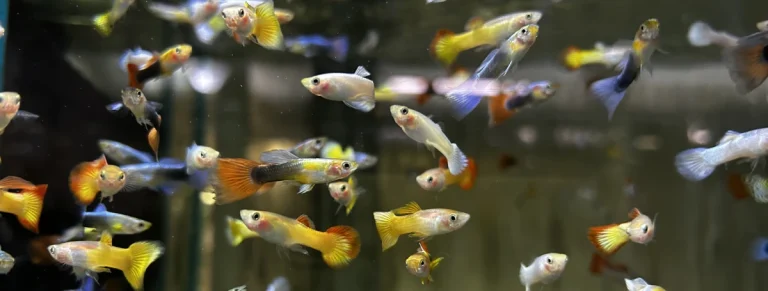
Guppies are technically middle swimmers but spend plenty of time near the surface. They're ideal for peaceful community tanks with other similarly sized fish, but keep fancy-tailed males away from bettas. Their long, colourful tails trigger aggression in most male bettas reliably.
The Middle Layer: The Heart of the Tank
The middle zone is where most of the action happens. Schooling fish spend their lives here, moving as a group through open water, and this is what gives a community tank its visual energy.
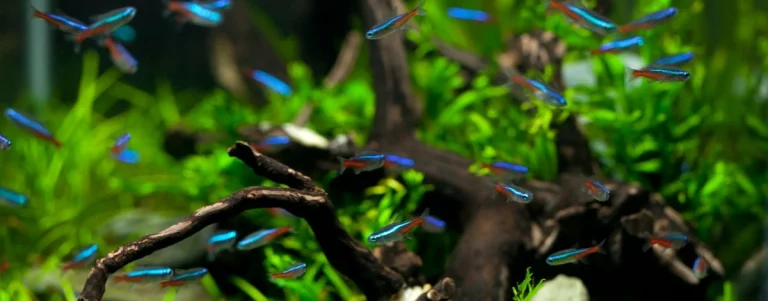
Neon and cardinal tetras are the classic choice. Small, peaceful, and stunning in a school of 8-10, they cause problems for almost nobody. The one exception: adult angelfish will eat them. Keep tetras with angelfish only if the angelfish are juvenile and the tank is large.
Harlequin rasboras are underrated. Deep orange and black, peaceful to everything, happiest in a school of 6 or more. They fill the middle zone without drama.
Rummy-nose tetras are another excellent choice for the middle. They're named for the vivid red blush on their snouts, and a school of 10+ against green plants looks genuinely spectacular.
Cherry barbs are a safer barb option for community tanks. Unlike tiger barbs, cherry barbs are peaceful, not prone to nipping, and the males develop a rich red colouration at maturity.
One important note on schooling fish: a school of 3 is not a school, it's a stressed, anxious group of fish trying to feel safe in numbers they don't have. Most schooling species need at least 6, ideally 8-10, to behave naturally and look their best. This is something to account for when planning stocking numbers.
The Bottom Layer: The Cleanup Crew
The bottom of the tank is often under-utilised in beginner setups, but it's where some of the hobby's most personable and useful fish live.
Corydoras catfish are the workhorses of the community tank bottom. They're completely peaceful, spend their time vacuuming the substrate for leftover food, and are more active and entertaining than most people expect. They do best in groups of 4-6 minimum. Panda cories, peppered cories, and bronze cories are all commonly available in Australia and work well in most setups.
Bristlenose plecos (bristlenose catfish) are the only pleco worth recommending for most home aquariums. Unlike the common pleco that grows enormous, bristlenose max out at around 12-15 cm. They rasp algae off glass and decorations, are completely peaceful, and add a prehistoric visual character to the tank. They need driftwood in their diet, so make sure a piece is always available.
Kuhli loaches are eel-shaped, nocturnal, endlessly fascinating, and almost never bother anything. They hide during the day and come out at feeding time to scavenge. Best kept in groups of 3-5 so they feel secure enough to actually come out and be seen.
The Most Common Pairings People Ask About
Can I keep a betta with tetras?
Yes, with caveats. Ember tetras and neon tetras can work in a tank of 60 litres or more, because they're fast enough to avoid a betta's attention and small enough not to register as a rival. The key variables are tank size and the individual betta's temperament. Some bettas ignore tank mates entirely. Others hunt everything. Introduce the betta last, after the other fish are established, and watch for the first 72 hours. If the betta is flaring constantly or actively chasing, remove the tetras before they're injured or find your new betta another tank.
Avoid fin-nipping tetras entirely with bettas. Serpae tetras, black skirt tetras, and silvertip tetras are all known fin nippers that will target a betta's flowing fins relentlessly.
Can I keep angelfish in a community tank?
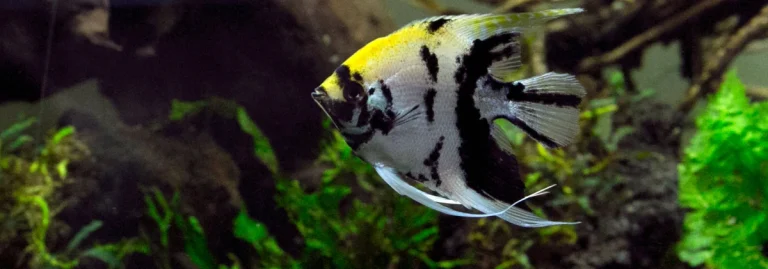
Angelfish are one of the most misunderstood community fish in the hobby. They're cichlids, and people forget that. Juvenile angelfish look innocent enough in a community tank at the shop. Adult angelfish, which reach 15 cm across, will eat neon tetras, small rasboras, and any other fish small enough to fit in their mouth.
The fish that work well with adult angelfish are larger tetras (like black widow tetras or congo tetras), corydoras, gouramis, and other similar-sized peaceful species. A breeding pair of angelfish will also defend their territory aggressively around spawning time, which means smaller or more timid tank mates can be terrorised.
If you want a tank with angelfish, plan around their adult size from the beginning. Don't buy small fish you love and then add juvenile angelfish expecting them to stay small.
Can I keep goldfish with tropical fish?
No. This comes up constantly and the answer is always the same. Goldfish are cold water fish that need 18-20°C. Tropical fish need 24-27°C. The temperature that suits one harms the other. There's no compromise point where both are healthy long-term. Keep goldfish in a goldfish tank, keep tropicals in a tropical tank.
Can I keep cichlids in a community tank?
It depends enormously on the species. Dwarf cichlids like rams (German blue rams, Bolivian rams) and Apistogrammas are genuinely peaceful for most community setups and can be stunning additions. They claim a small territory on the bottom but generally leave other fish alone in a well-planted tank.
Large or aggressive cichlids, including most African rift lake cichlids, oscars, convicts, and jack dempseys, are not community fish. They're best kept with other cichlids of similar size and aggression, in dedicated cichlid setups with appropriate water chemistry.
The Classic Mistakes
Buying based on looks alone. The most common mistake in the hobby. That beautiful fish at the shop is beautiful for 30 seconds before it eats your tetras, destroys your plants, or gets shredded by whatever was already in the tank. Research first, buy second, every time.
Trusting "community fish" labels. Shop labels are a starting point, not a guarantee. "Community fish" means the species is generally peaceful, not that it works with everything. A tiger barb is technically a community fish that will absolutely harass your betta.
Ignoring adult size. A 4 cm fish becomes a 15 cm fish. Plan for what it will be, not what it is today.
Understocking schooling fish. A school of 3 neon tetras is not a school. It's a stressed trio. Stock schooling fish properly or don't stock them at all.
Adding too many fish too fast. Your filter's bacteria colony grows to match the bioload in the tank. Add 20 fish at once and you'll spike ammonia. Add fish in small groups over several weeks and the tank adjusts without crisis.
Not rearranging before adding new fish. When you add a new fish to an established tank, the existing fish have already claimed territory. Move a few decorations and plants before the new fish goes in. It levels the playing field and significantly reduces the aggression directed at the newcomer.
A Simple Starter Community for a 60-80 Litre Tank
If you want a peaceful, visually layered, easy-to-maintain tank that will work right from the start, this combination is hard to beat:
Top/middle: 8-10 neon or cardinal tetras
Middle: 6 harlequin rasboras
Bottom: 4-6 panda or peppered corydoras
Bottom/surface: 1 bristlenose pleco
Add a school of cherry shrimp if you want colour at the substrate level and a live cleanup crew for algae. This combination shares similar water parameters, occupies different zones, and is peaceful across the board. It's not the only answer, but it's a reliable one that leaves you room to understand your tank before experimenting further.
The Mindset That Makes This All Easier
The hobbyists who rarely lose fish and rarely have aggression problems all have one thing in common: they research before they buy, not after something goes wrong.
A five-minute search before you leave for the shop is worth more than any medication after the fact. Know your tank size, know your water parameters, know what's already in the tank, and match new purchases to all three.
The tank you plan properly from the start is the tank that's still running beautifully three years later.
Browse the LiveFish freshwater collection to find the species mentioned in this guide, or get in touch if you want advice on building a community for your specific tank size and setup. We'd rather help you get it right the first time.
Download the compatibility guide here