How Much and How Often Should You Feed Your Fish?
In This Guide
- 1. A Week at the Glass
- 2. The Begging Is a Beautiful Lie
- 3. Monday Morning: How Much?
- 4. Monday Night: How Often?
- 5. Wednesday: The Surprise in the Plants
- 6. Saturday: The Water Turns
- 7. Sunday: The Day Off
- 8. Months Later: Winter Arrives
- 9. Quick Reference
- 10. Myths: Fact vs. Fiction
- 11. Monday Again
A Week at the Glass
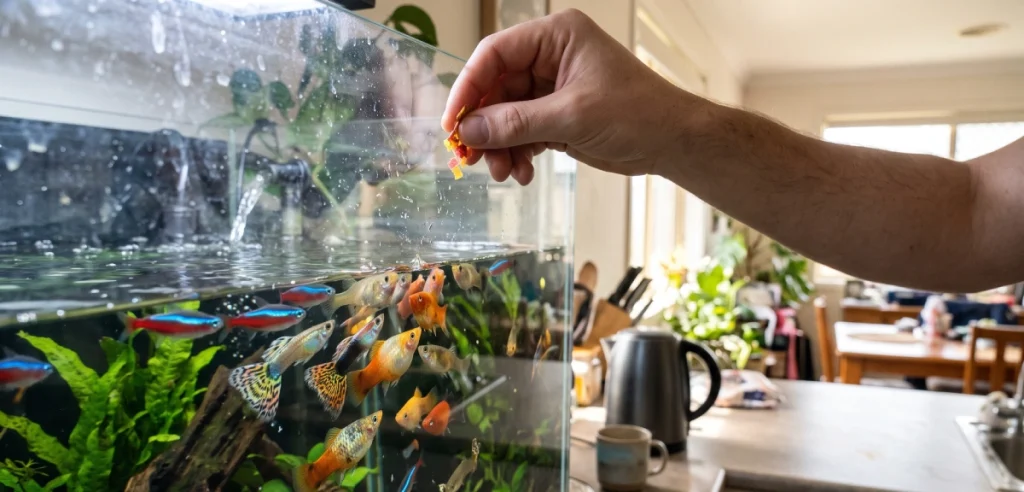
It's Monday morning and you've barely flicked the kettle on when the whole school is pressed against the front glass. Mouths working, fins flared, every one of them looking as though nobody has fed them since Christmas. You shake in a pinch of flakes, and because they still look keen, you add a little more.
That second pinch is where most feeding problems begin. Overfeeding is one of the most common reasons aquarium fish get sick, and it rarely happens in one big meal. It builds quietly, a pinch at a time, until one day the water turns.
So let's spend a week together at your tank. We'll go from that Monday morning feed to a fasting Sunday, with a surprise or two along the way. By the end you'll know how much to give, how often, and what your fish are really asking for when they crowd the glass.
In This Guide
- The Begging Is a Beautiful Lie
- Monday Morning: How Much?
- Monday Night: How Often?
- Wednesday: The Surprise in the Plants
- Saturday: The Water Turns
- Sunday: The Day Off
- Months Later: Winter Arrives
- Quick Reference
- Myths: Fact vs. Fiction
The Begging Is a Beautiful Lie
Before Monday's first pinch, it helps to know what all that begging means.
In the wild, food turns up when it turns up. A cloud of mosquito larvae after rain, then not much for days. The fish that ate whenever they had the chance were the ones that made it through the lean spells, and your fish carry that instinct straight into your living room.
They've also learnt that you are where food comes from. A fish crowding the glass ten minutes after a meal is acting on both of those instincts, and it has very little to do with an empty stomach.
In your tank, the lean spell never comes. Every extra pinch ends up as fat on the fish or as waste in the water, and on Saturday you'll see what that waste can do.
Monday Morning: How Much?
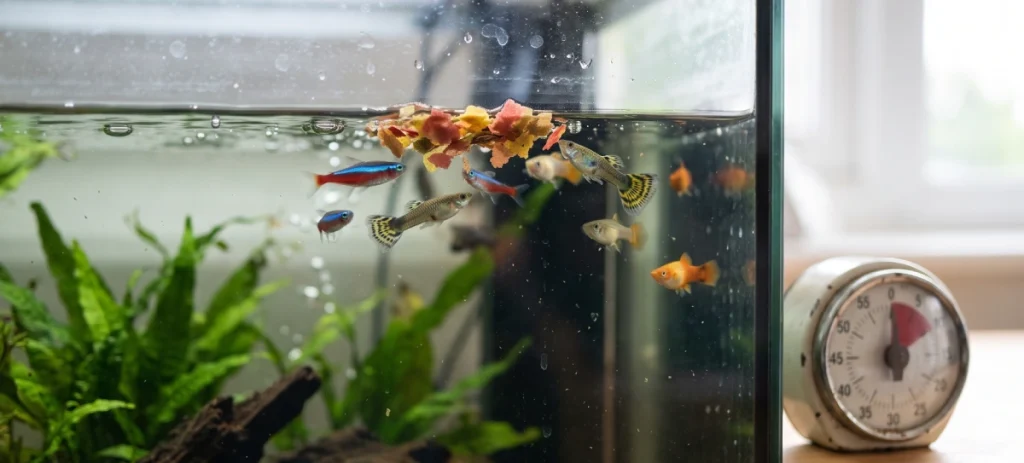
Back to the kettle. This time, before you reach for the tub, settle in to watch for a couple of minutes.
Our experts recommend feeding only what your fish will finish in about 2 minutes. It suits nearly every fish in a community tank, and it's easy to learn.
Start with a smaller pinch than feels right and stay at the glass. If it's gone inside a minute, add a touch more tomorrow. If flakes are still drifting, or sitting on the gravel when the 2 minutes are up, that was too much: net out the leftovers and give less next time. Within a week your fingers will know the right pinch on their own.
It helps to picture how small a fish's stomach really is. A rough guide many keepers use is that it's about the size of the fish's eye. Hold that picture next to a pinch of flakes and you'll see why a little goes such a long way.
While you're watching, notice who's actually eating. Danios and barbs can strip the surface before your shyer fish realise breakfast has arrived, and your bottom dwellers may see nothing at all. The 2 minutes are for the whole tank, not just its quickest members. If the slower fish are missing out, our guide Top, Middle or Bottom: Matching the Right Food to Your Fish shows you how to get food to every level.
Monday Night: How Often?
By evening the school is back at the glass. This time they've earned it.
For most adult tropical fish, our experts recommend 1–2 small meals a day. A small breakfast and a small dinner work better than one big feed, because less goes uneaten and a modest meal is easier to digest. Leave the lights on for at least half an hour afterwards so everyone can find their share. A community of guppies, platys and danios settles happily into this routine.
If you keep a betta, go even smaller. Bettas bloat easily, and two or three pellets once or twice a day is plenty. Our betta food range has pellets sized for their small mouths.
Then you switch the tank light off, and the night shift starts work. Bristlenose catfish and many loaches do most of their foraging in the dark, so drop a sinking wafer in just before lights-out. It reaches them before the day crowd can get to it.
Wednesday: The Surprise in the Plants
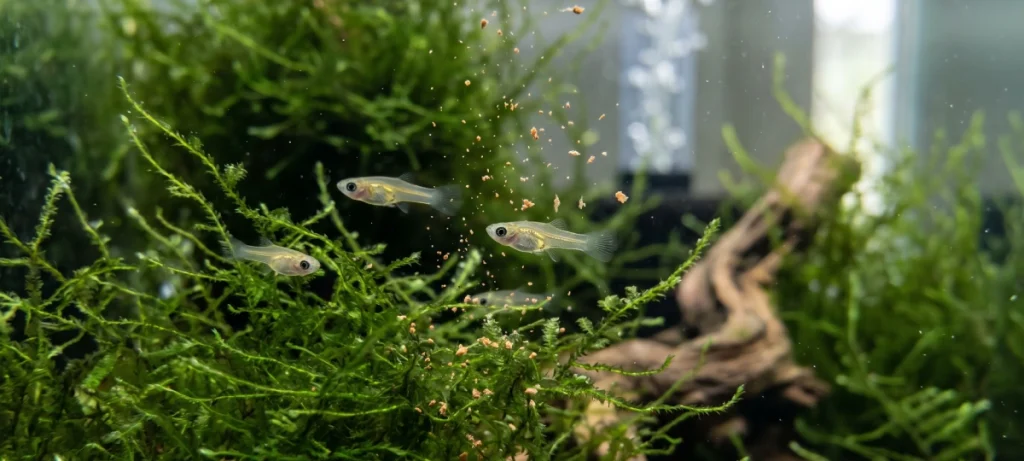
Midweek you spot something tucked into the plants: tiny eyes, and tails no bigger than an eyelash. Your guppies have had babies.
Fry turn the rules upside down. They grow fast and carry almost no reserves, so they need 3–5 tiny feeds a day of finely crushed flake or a powdered fry food. Rub the flakes between finger and thumb until they're nearly dust. Our guppy food range includes fine-grain foods that suit fry as well as the adults.
Feeding that often means more waste, so keep the water fresh with small, regular water changes while the youngsters grow.
Saturday: The Water Turns
Say the week hasn't gone perfectly. A few mornings the pinch was on the generous side, and on Thursday you were running late and tipped in extra to make up for it. Nobody would blame you. Then on Saturday you notice a faint milky haze in the water, and a green film creeping across the front glass.
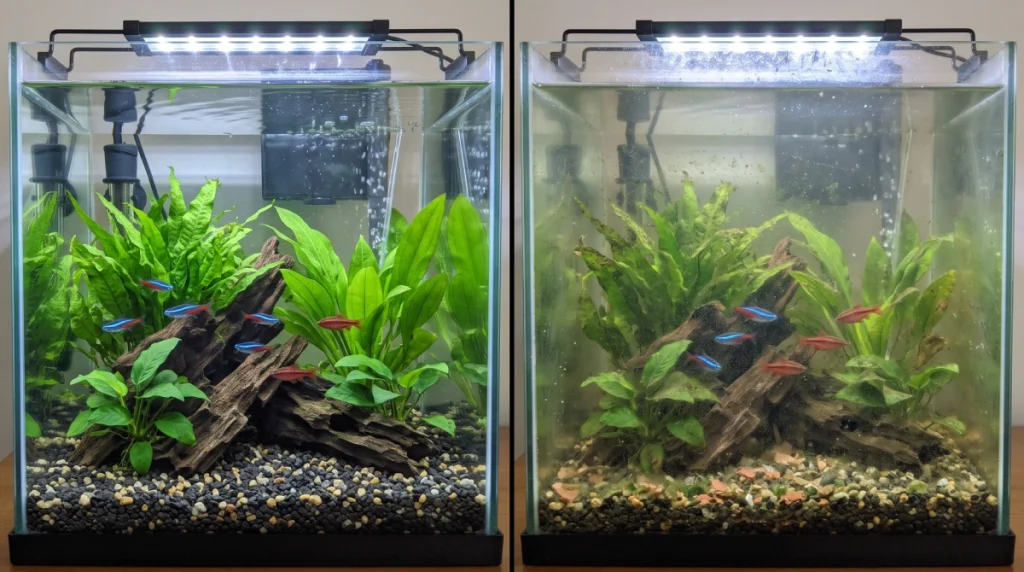
Food your fish don't eat doesn't vanish. It sinks into the gravel and rots, and rotting food releases ammonia, the same toxic compound fish give off as waste. In a cycled tank, good bacteria living in your filter turn ammonia into nitrite, then into far less harmful nitrate. That's the nitrogen cycle, and it's why every tank needs cycling before fish go in. You can read more in our guide on how to cycle a fish tank the right way.
Those bacteria can only process so much. Overfeed for a few days and the waste gets ahead of them. The haze is often a bloom of bacteria living off the excess, and the algae is enjoying the extra nutrients too. Meanwhile your fish are swimming in water that irritates their gills, and stressed fish pick up disease more easily.
A few other clues tend to turn up alongside: food still lying on the gravel after a feed, long stringy droppings trailing behind your fish, and swollen bellies, particularly in bettas and fancy goldfish.
The Pro Move: When something looks off, test the water before you feed. Any reading above 0ppm ammonia or nitrite means skip the next meal, do a 20–25% water change and halve portions for a week. Our Aquarium Water Quality 101 guide walks you through testing step by step.
Here's some honest advice: underfeeding is rare in home tanks, so when in doubt, lean towards less. A fish that's genuinely going short shows a pinched, hollow belly, picks at plants all day and may start nipping the fins of tank mates it used to ignore. Young fish simply stop growing. If one fish is thin while the rest look well, the cause is usually competition at mealtimes or illness rather than the amount you're giving, and our fish diagnosis guide can help you work out which.
Sunday: The Day Off
On Sunday, leave the tub in the cupboard. Our experts recommend one fasting day a week for healthy adult fish.
A day without food lets your fish's digestive system clear, helps prevent bloating and constipation, and gives your filter bacteria time to catch up after Saturday. Wild fish go without far more often than once a week, and a healthy adult copes with a day off easily. They'll still beg at the glass, of course, but by now you know what that means.
Skip the fasting day for fry, and for any fish that's thin, unwell or newly arrived.
Months Later: Winter Arrives
Fast forward a few months. The routine is second nature, the water's clear, and it's June. In Melbourne, Canberra or Hobart the house cools right down overnight, and your fish feel it.
Fish are cold-blooded, so their appetite rises and falls with the water temperature.
- Heated tropical tanks - feed as normal all year, but check your heater is holding 24–26°C on the coldest nights
- Unheated tanks and ponds - appetite slows as the water cools. Goldfish need less food once the water drops below about 15°C, and below about 10°C pond goldfish barely digest anything, so stop feeding until spring warms things up. Then ease back in with small feeds of a goldfish and koi food
- Summer heatwaves - warm water holds less oxygen and leftovers rot faster, so keep meals small on very hot days
The seasons are also a good reminder to check the cupboard. Once a tub is open, its vitamins break down with air, heat and humidity. Buy a size you'll use within about 3 months, keep the lid on tight, and store it somewhere cool and dry, never on top of a warm light. If you run several tanks, our bulk buy fish foods make sense, because you'll get through them while they're fresh.
Treats fit into the same rhythm. Frozen bloodworm, brine shrimp and daphnia are best swapped in for a regular meal 2–3 times a week rather than added on top. Our food guide explains why they make a better treat than a main course.
Quick Reference
| Feature | Requirement | Why |
|---|---|---|
| Portion size | What's eaten in about 2 minutes | Leftovers rot into ammonia |
| Adult fish | 1–2 small meals a day | Small meals digest better and waste less |
| Fry | 3–5 tiny feeds a day | They grow fast and have no reserves |
| Night foragers | A sinking wafer at lights-out | Day-active fish eat it first otherwise |
| Fasting day | 1 day a week, healthy adults only | Clears the gut and helps prevent bloat |
| Treats | 2–3 times a week, in place of a meal | Variety without overloading the water |
| Cold, unheated water | Feed less below 15°C, stop below 10°C | Digestion slows right down in the cold |
Myths: Fact vs. Fiction
"My fish are always hungry, so they need more food." Reality: Fish are built to eat whenever food appears, and they've learnt that you bring it. Crowding the glass is habit and instinct far more often than hunger.
"The catfish will tidy up whatever the others leave." Reality: Bottom feeders need meals of their own, and they can't reach food buried deep in the gravel. Whatever they miss still rots. Feed the whole tank to the 2-minute rule and give your bottom dwellers their own sinking food.
"Skipping a meal will harm my fish." Reality: A healthy adult fish copes easily with a day or two without food, and a weekly fasting day does it good. An overfed tank is a far bigger risk than a missed meal.
Monday Again
The kettle's on, and the school is pressed against the glass just like last week. That part will never change, and you wouldn't want it to.
The difference is in your hand. One small pinch, two minutes at the glass, nothing left on the gravel by the time your tea's brewed. Clear water, bright colours, and a tank full of fish with all the energy of fish that are properly looked after. Same time next Monday.