Who Feeds the Fish? Holiday Feeding for an Aussie Summer
In This Guide
- 1. Packing the Car
- 2. Less Fragile Than You Think
- 3. The Countdown
- 4. Fourteen days out
- 5. Seven days out
- 6. Three days out
- 7. The morning you leave
- 8. Choosing Your Holiday Feeding Plan
- 9. Option 1: A planned fast
- 10. Option 2: Holiday food blocks
- 11. Option 3: An automatic feeder
- 12. Option 4: A friend with a pill box
- 13. The Real Summer Risk: Heat
- 14. Home Again: The First 48 Hours
- 15. Quick Reference
- 16. Myths: Fact vs. Fiction
- 17. The Glass, Unchanged
Packing the Car
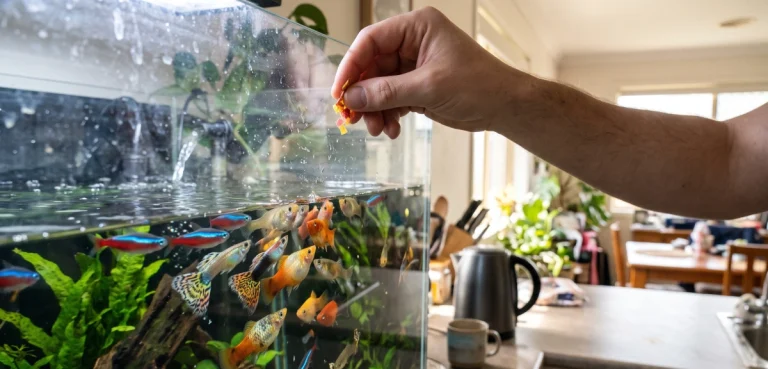
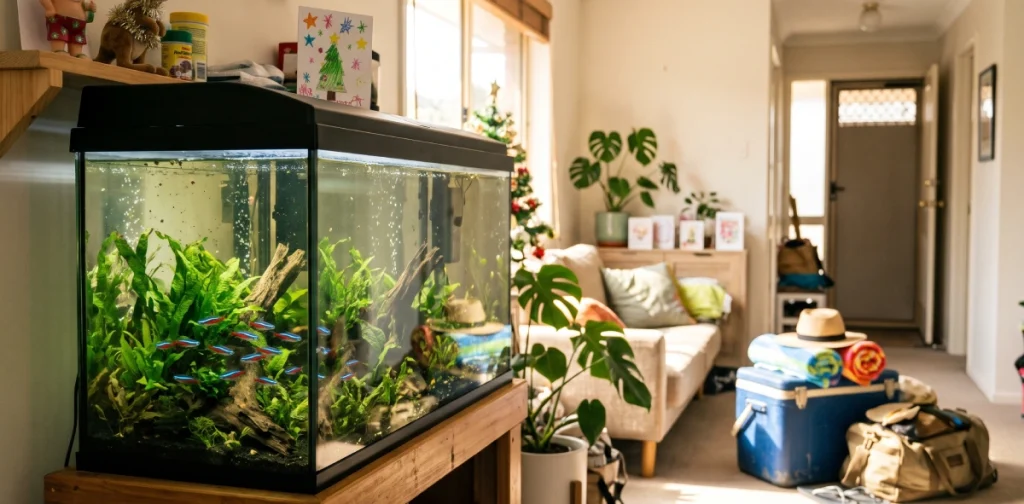
It's the week before Christmas. The car boot is half full, the esky is in the hallway, and someone is hunting for the beach towels. Then you walk past the tank, the tetras swing round to the glass, and the thought lands: who's going to feed the fish?
Plenty of holidays start with a frantic last-minute fix. A neighbour gets a tub of flakes and a vague "just a pinch", or a holiday block gets dropped in on the way out the door. Either can work, or go quite badly wrong, and in an Australian summer the bigger danger often isn't hunger at all.
Let's plan it properly. We'll start two weeks before you leave, choose the right feeding option for the length of your trip, get the tank ready for a heatwave, and finish with what to do when you walk back through the door.
In This Guide
- Less Fragile Than You Think
- The Countdown
- Choosing Your Holiday Feeding Plan
- The Real Summer Risk: Heat
- Home Again: The First 48 Hours
- Quick Reference
- Myths: Fact vs. Fiction
Less Fragile Than You Think
Stand at the tank for a moment. Those tetras crowd the glass as though they live from one meal to the next, but a healthy adult fish copes with a short break far better than you'd expect.
Fish are cold-blooded, so they burn much less energy than we do, and wild fish regularly go days between good meals. A well-fed adult in a settled tank can comfortably go 3–4 days without food, and most will manage a week without any lasting harm. They'll pick at algae and bits of plant in the meantime, and they'll be very pleased to see you.
The usual way it goes wrong is the opposite one. A well-meaning neighbour sees the fish begging, adds a generous pinch every day, and by the time you're home the water is cloudy and the ammonia is climbing. If you've read our guide to how much and how often to feed your fish, you'll know why.
There are exceptions. Fry, very small nano fish and anything thin or recently unwell have little in reserve, so they need feeding while you're away, even on a short trip.
The Countdown
A good holiday for your fish starts well before the car is packed. The aim is a tank that's settled and boring by the day you leave, so nothing changes while you're gone.
Fourteen days out
The leave is booked and the dates are on the fridge. This is the point to stop adding fish. New arrivals take a week or two to settle, and that's when problems tend to show, so our experts recommend adding no new fish in the fortnight before you go away. Anything you've had your eye on can wait until you're home.
It's also your last chance to clean the filter. Cleaning disturbs the good bacteria that break down waste, and they need around two weeks to recover. Rinse the sponges in old tank water, never under the tap, where chlorine would kill the very bacteria you're trying to keep.
Now start a dry run of whichever feeding plan you choose below. Set the automatic feeder going while you're still around to watch it, or drop in a holiday block and see how your water reacts.
Seven days out
Time to hand over the keys. Walk your neighbour through the routine on a weekend morning: where the food lives, how much to give, and what the tank normally looks like when all is well. Ten minutes now saves a worried phone call when you're lying on a beach in Byron Bay.
While you're at it, fit a cheap plug-in timer to the tank lights and set it for 8–10 hours a day. Lights left on around the clock feed an algae bloom, and a fortnight of darkness is hard on your plants.
Three days out
Test the water and do a 20–25% water change, treating the new water with a conditioner to neutralise the chlorine and chloramine in Australian tap water. Doing it now, rather than the night before, leaves a few days to spot anything odd. If you're not sure what to test for, Aquarium Water Quality 101 has the full rundown.
The morning you leave
Give the fish their usual breakfast, not a farewell feast. Check the heater, the filter and the light timer one last time, close the blinds in the tank room, and lock the door behind you.
Choosing Your Holiday Feeding Plan
The right plan depends mostly on how long you'll be away. Find your trip below, then read on for how each option works.
| Time away | Healthy adult fish | Fry, nano fish or a fish that's unwell |
|---|---|---|
| Up to 4 days | No food needed | Automatic feeder or a visitor |
| 5–7 days | No food, or one visit midway | Automatic feeder or a visitor every 2 days |
| 1–2 weeks | Automatic feeder or a visitor every 2–3 days | Visitor every 2 days, plus an automatic feeder |
| Over 2 weeks | Someone who knows fish, visiting regularly | Someone who knows fish, visiting regularly |
Option 1: A planned fast
For a long weekend away, healthy adult fish don't need feeding at all. Give them their usual meal the morning you leave, not a bigger one, and let them graze on what the tank provides. A heavy farewell meal only adds waste while nobody's there to deal with it.
Option 2: Holiday food blocks
Holiday blocks release food slowly as they dissolve, and they're handy for trips of up to a week or two. Here's some honest advice, though: not all blocks are equal. The older plaster-style blocks can harden your water and cloud it as they break down, which is a problem in soft-water tanks. Gel-based holiday foods are much gentler. Whichever you choose, drop one in a week before you leave and watch it for a couple of days, so you know it suits your fish and your water.
Option 3: An automatic feeder
A battery-powered automatic feeder clips to the tank and tips out a measured portion once or twice a day. It's the most reliable option for trips of a week or longer. Fill it with a dry staple like a tropical community fish food, set it to roughly half your normal portion, and fit fresh batteries before you go. Keep the feeder clear of the lid's condensation, because damp flakes clump and jam.
Option 4: A friend with a pill box
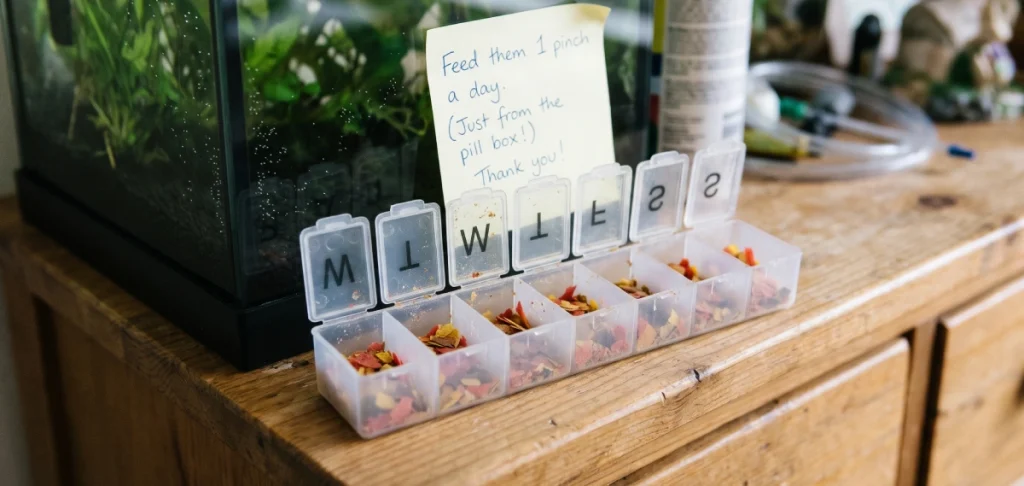
A neighbour or friend can do a great job, as long as they don't have to guess. Buy a weekly pill organiser, fill one compartment per visit with a measured portion, and put the tub of food away somewhere out of sight. Leave a short note on the tank: which compartment is which day, "don't add extra, even if they beg", and your phone number. Then ask them to send a quick photo of the tank each visit. It's reassuring for you, and it shows you straight away if the water starts to cloud.
The Real Summer Risk: Heat
Picture the house on day four of your trip. The blinds are open, it's 41°C outside in Adelaide, and the air conditioning is switched off. The living room bakes, and the tank sits in the middle of it.
For fish, a hot week is far more dangerous than a missed meal. Your heater can warm the water, but it can't cool it. Most tropical fish are happiest at 24–26°C, and once the water climbs past about 30°C they start to struggle. Warm water also holds less oxygen, just as the fish need more of it, and any leftover food breaks down faster.
A few simple steps make a big difference:
- Move the tank out of direct sun - or at least close the blinds and curtains in that room
- Turn the heater down to 24°C - so it doesn't add warmth on a day that's already hot
- Increase surface movement - angle the filter outlet to ripple the surface, which helps oxygen get in
- Leave the lid slightly open - a gap lets warm air escape, as long as your fish aren't jumpers
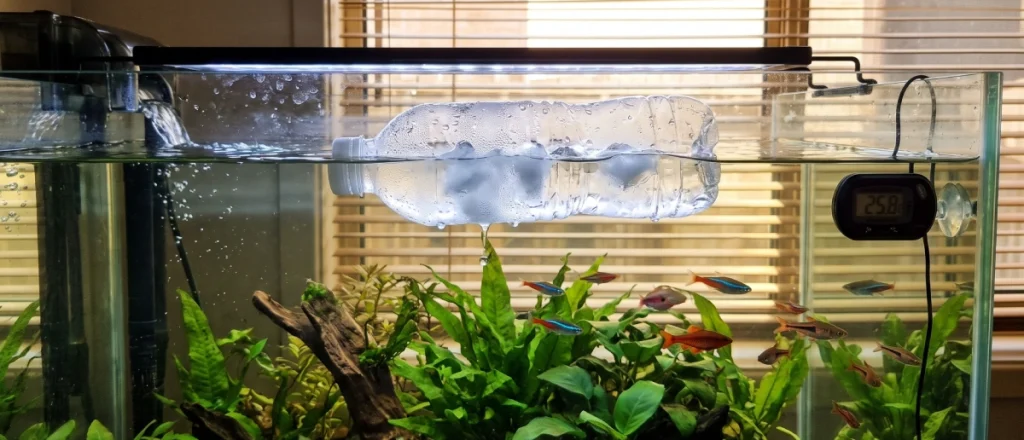
- Brief your visitor on a heatwave plan - if the tank reads above 30°C, float a sealed bottle of frozen water in it and swap it for a fresh one each day
Summer storms bring a second risk: power cuts. Without power the filter stops, and after a few hours the oxygen starts to drop. If your area loses power often, a battery-powered air pump is a cheap insurance policy. Ask your visitor to check the filter is running each time they call in.
Home Again: The First 48 Hours
The bags are dumped in the hallway, there's sand in the car, and before you've even put the kettle on you're crouched in front of the tank. This is the moment that matters most, and it's tempting to get it wrong.
The fish will mob the glass, and every instinct says to make up for lost meals. Resist it. Their digestion has slowed while you were away, and a big meal now lands on a gut that isn't ready and a filter that's been ticking over quietly.
Instead, take it slowly:
- Count heads. Make sure everyone's there, and look behind the décor for anyone missing.
- Check the temperature and the filter. Both should be exactly where you left them.
- Test the water. Ammonia and nitrite should both read 0ppm. If either is up, do a 20–25% water change before anything else.
- Feed a small meal. About half a normal portion on day one, then back to your usual routine from day two.
- Clear out the leftovers. Remove any undissolved holiday block and take down the automatic feeder, so you don't double-feed by accident.
If a fish looks thin, pale or unwell after the break, our fish diagnosis guide will help you work out what's going on.
Quick Reference
| Feature | Requirement | Why |
|---|---|---|
| New fish | None in the 2 weeks before you leave | New arrivals are most at risk in their first fortnight |
| Water change | 20–25%, 3–5 days before you go | Fresh water, with time to spot problems |
| Filter clean | At least 2 weeks before | Good bacteria need time to recover |
| Short trips | Up to 4 days, no food for healthy adults | They cope easily; extra food only adds waste |
| Longer trips | Automatic feeder or a visitor with portions | Measured food, no guessing |
| Heat | Keep the tank below 30°C, out of the sun | Hot water holds less oxygen |
| Coming home | Test first, then half a meal | Their digestion and filter need easing back in |
Myths: Fact vs. Fiction
"My fish will starve if I'm away for a week." Reality: Healthy adult fish can go 3–4 days without food comfortably, and most manage a week. Overfeeding by a well-meaning visitor is the bigger danger.
"I should give them a big meal before I leave." Reality: A farewell feast mostly ends up as waste in the water, just as you're leaving. Give them their normal portion and go.
"A holiday block is set-and-forget." Reality: Some blocks cloud the water or change its hardness as they dissolve. Test one at home first, so you know how your tank reacts.
The Glass, Unchanged
It's the middle of January. You open the front door, drop the bags, and walk straight to the tank. The water is clear, the thermometer reads 25°C, and the tetras swing round to the glass exactly as they did the day you packed the car.
You give them half a pinch. They'll get the rest tomorrow.