Two Continents, Two Personalities: African vs American Cichlids for Beginners
In This Guide
- 1. Why You Can't Have Both in One Tank
- 2. Two Continents, Two Personalities
- 3. Start With Your Tap Water
- 4. Space and the Starter Kit
- 5. The Filter
- 6. The Heater
- 7. The Lid
- 8. Building Two Very Different Homes
- 9. An Invisible Science: the Nitrogen Cycle
- 10. Best First Cichlids
- 11. Feeding
- 12. The Weekly Rhythm
- 13. Which One Is Right for You?
- 14. Quick Reference: Cichlids at a Glance
- 15. Myths: Fact vs. Fiction
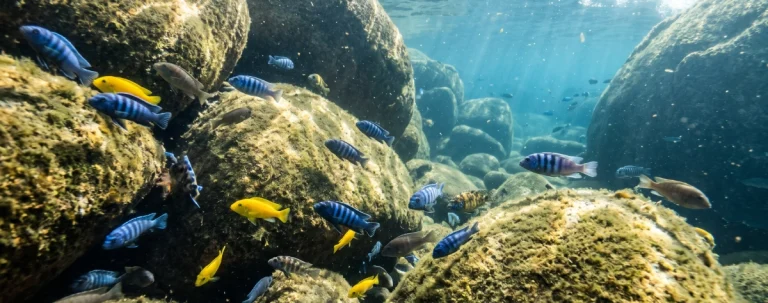
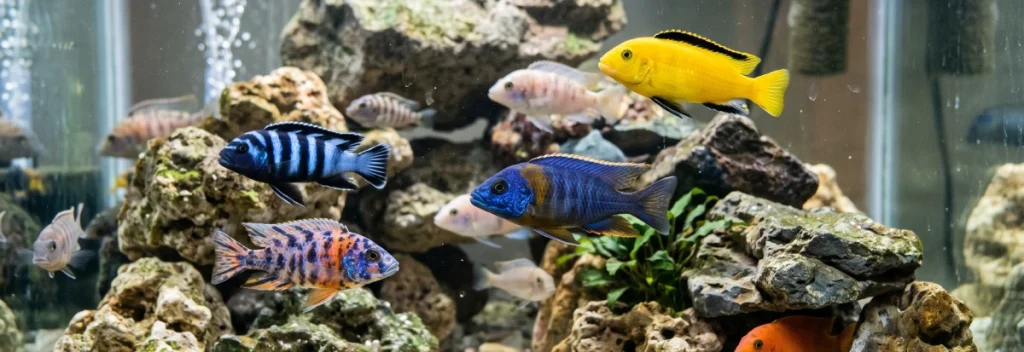
Picture a wall of rock under water so clear you can see ten metres in every direction. Hundreds of electric-blue and lemon-yellow fish dart in and out of the cracks, each one guarding its own little patch. That's Lake Malawi, home of the African cichlid.
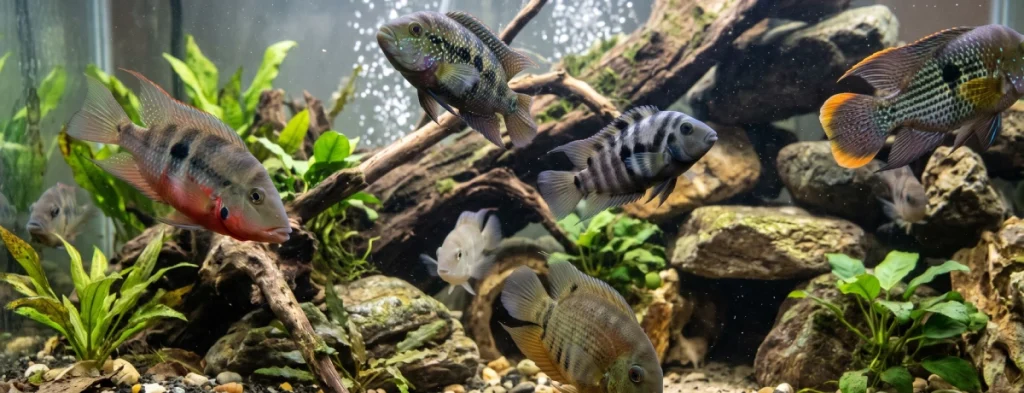
Now picture a slow, tea-coloured creek under a rainforest canopy, the bottom covered in fallen leaves. A pair of fish hovers over a nest of tiny fry, the parents taking turns to chase off anything that comes too close. That's the world of the American cichlid.
Both are cichlids. Both are clever, colourful and full of personality, and both can be brilliant first cichlids. But they come from opposite sides of the planet, and they need opposite tanks.
Why You Can't Have Both in One Tank
The most common cichlid question we hear is whether Africans and Americans can share a tank. The honest answer is no, and the reason isn't really aggression. It's water.
African rift-lake cichlids need hard, alkaline water. Most American cichlids prefer it softer and closer to neutral. Split the difference and you get a tank that suits neither, with stressed fish on both sides.
Two Continents, Two Personalities
African cichlids from Lake Malawi are the busy, bright rock-dwellers. Most stay 8–15cm, live in colourful groups rather than pairs, and spend their day sorting out who owns which rock. Mbuna like the Electric Yellow graze algae off the rocks; Peacocks hunt over the sand.
American cichlids from Central and South America are the characters and the parents. Many form pairs, raise their fry together and get to know the person who feeds them. They range from 5cm Rams to the 20cm+ Jack Dempsey, and the group also includes angelfish, discus and oscars.
| African (Lake Malawi) | American (Central and South) | |
|---|---|---|
| Water | Hard, alkaline, pH 7.8–8.6 | Softer, pH 6.5–7.5 for most |
| Temperature | 24–27°C | 24–28°C, Rams warmer |
| Social style | Busy groups | Pairs and families |
| Décor | Rock piles and sand | Wood, leaves and plants |
| Colour | Bright from a young age | Often develops with maturity |
Browse both sides in our Cichlids range.
Start With Your Tap Water
Before you pick a continent, test what comes out of your tap. Australian tap water varies a lot from one city to the next, and it's the single biggest factor in which cichlids will be easy for you.
A simple test kit that reads pH and hardness (GH and KH) tells you most of what you need. Hard, alkaline tap water gives Africans a head start. Soft water suits many Americans straight away, though Africans can still work with crushed coral or limestone rock in the tank to lift and steady the pH. Whatever your water, stability matters far more than chasing a perfect number.
Space and the Starter Kit
Cichlids are territorial, and territory takes floor space. Our experts recommend at least 200 litres and a 120cm-long tank for a Malawi community. A pair of dwarf Americans like Rams or Kribensis can live happily in 80–100 litres, while a Jack Dempsey needs 300 litres or more.
Buy your gear at least two weeks before your fish.
The Filter
Africans are kept in busy groups and produce plenty of waste, so choose a canister filter rated above your tank's volume. Dwarf Americans prefer gentler flow, so a well-baffled filter suits them better.
The Heater
Both sides are tropical. Set an adjustable heater to 25–26°C for most species, and closer to 28°C for Rams. Southern winters make a thermostat essential.
The Lid
Cichlids chase, and chased fish jump. A secure lid saves a lot of heartache.
Building Two Very Different Homes
An African tank is all about rock. Stack it high and stable, right down to the glass, with plenty of caves and gaps so every fish can claim a home and escape when chased. Sand on the bottom lets Peacocks sift for food. Plants are optional, as most Africans dig them up.
An American tank looks like a forest stream: driftwood, a few caves, leaf litter and hardy plants like Java Fern, Anubias and Amazon Sword. Dwarf species use caves as nurseries, so a coconut cave or two can lead to the best show in the hobby, a pair raising their fry.
An Invisible Science: the Nitrogen Cycle
A brand-new tank has none of the bacteria that make fish waste safe. Fish produce toxic ammonia; bacteria turn it into nitrite, still toxic, then into nitrate, which water changes remove. Building that bacteria is called cycling.
The Pro Move: Add a pinch of fish food to the empty, running tank every day for two to three weeks. When ammonia and nitrite both read 0ppm, it's ready. Our guide on How to Cycle a Fish Tank the Right Way has the full method.
Best First Cichlids
From Africa:
- Electric Yellow (Labidochromis caeruleus): a lemon-yellow mbuna around 8–10cm, and one of the calmest of its kind
- Peacock (Aulonocara): males glow blue, red or gold at 12–15cm, and are gentler than most mbuna
Peacocks and Electric Yellows can share a tank, but keep Peacocks away from the more aggressive mbuna, which bully them. Stock Malawi tanks with more females than males, roughly three to one, to spread out the chasing.
From the Americas:
- Ram (Mikrogeophagus ramirezi): a jewel-like dwarf of 5–7cm that wants warm, very clean water
- Jack Dempsey (Rocio octofasciata): a stunning, intelligent fish, but at 20cm+ and with a temper to match, it's a fish for a big tank of its own
One that breaks the rules: the Kribensis. The Krib (Pelvicachromis pulcher) is actually African, but it comes from soft-water West African rivers rather than the rift lakes. It wants the same set-up as a dwarf American: softer water, plants and a cave. At 7–10cm, hardy and full of personality, it's often the first cichlid our experts recommend.
Cichlids rarely suit tiny community fish, but dwarf Americans and Kribs get along well with tetras, corydoras and rasboras. Larger American cichlids include angelfish, which have their own guide.
Feeding
Most Malawi mbuna are grazers with long guts built for plant matter, and even the more omnivorous Electric Yellow does best on a spirulina-based flake or pellet. Rich foods like bloodworm can cause bloat in these fish, so keep them as a rare treat. Peacocks and most Americans eat more protein: a quality cichlid pellet, plus frozen brine shrimp or bloodworm two or three times a week.
Feed small amounts once or twice a day and fast them one day a week.
The Weekly Rhythm
Weekly: Change 25–30% of the water. A busy African tank produces a lot of waste. Always treat new water with conditioner.
Monthly: Rinse filter media in old tank water and check that your rockwork is still stable.
Always: Watch for one fish being singled out. Constant hiding, torn fins or a fish hanging at the surface means it's time to rearrange the rocks or rehome a bully.
Which One Is Right for You?
Go African for a 200-litre-plus tank, hard or easily buffered tap water, and a love of non-stop colour and movement. A well-stocked Malawi tank looks like a reef in freshwater.
Go American for a planted, natural-looking tank, softer water, and the chance to watch a pair raise a family. A dwarf species like a Ram, or the honorary American, the Kribensis, is the gentlest way in.
Quick Reference: Cichlids at a Glance
| Feature | Requirement | Why |
|---|---|---|
| Tank size | Malawi 200 litres+; dwarf pair 80–100 litres | Territory needs floor space |
| Water | African pH 7.8–8.6; American pH 6.5–7.5 | Matches their home waters |
| Temperature | 24–27°C; Rams up to 28–29°C | Tropical, stability is key |
| Décor | African rock and sand; American wood and plants | Caves and cover reduce aggression |
| Stocking | Malawi more females than males | Spreads out chasing |
| Mixing | Never Africans with Americans | Opposite water needs |
Myths: Fact vs. Fiction
Myth: "Cichlids are too aggressive for beginners." Reality: Kribs, Rams, Electric Yellows and Peacocks are all good first cichlids. Most aggression comes from the wrong tank size, décor or stocking.
Myth: "Africans and Americans can live together in a big enough tank." Reality: Size doesn't fix water chemistry. One side will always be living in the wrong water.
Myth: "You need perfect pH numbers." Reality: Stable water beats perfect water. Swinging your pH around with chemicals does more harm than a steady reading slightly off the ideal.
Whether it's the rocky shallows of Lake Malawi or a leafy Amazon creek, you can have that scene in your living room. Start with your tap water, choose the continent that suits it, and give your cichlids the home they were built for. They'll repay you with more personality than almost any fish in the hobby.