The Ultimate Beginner's Guide to a Guppy Tank
In This Guide
- 1. Why the Setup Actually Matters
- 2. How Much Space Do You Need?
- 3. The Guppy Starter Kit - What You Need Before Day One
- 4. The Filter - Go Gentle
- 5. The Heater - Worth Fitting Year-Round
- 6. The Lid
- 7. Plants - Vital for the Perfect Guppy Tank
- 8. The Nitrogen Cycle - Never Skip This Step!
- 9. Choosing Your Guppies - and Building Their Community
- 10. Feeding - Small Fish, Real Appetite
- 11. The Part Nobody Warns You About - They Will Breed!
- 12. Weekly Maintenance - Easier Than You Think
- 13. Quick Reference: Guppy Setup at a Glance
- 14. Common Guppy Myths: Facts vs. Fiction
Where Every Fish Will Thrive
People often ask us why guppies are the perfect beginner fish. They're hardy and beautiful, of course, and they offer all the excitement of live births. But why guppies really reward new owners - whether they're inquisitive children or nature-loving adults dipping their toe in the water for the first time - is that once you take on a guppy, you'll want to have fish forever.
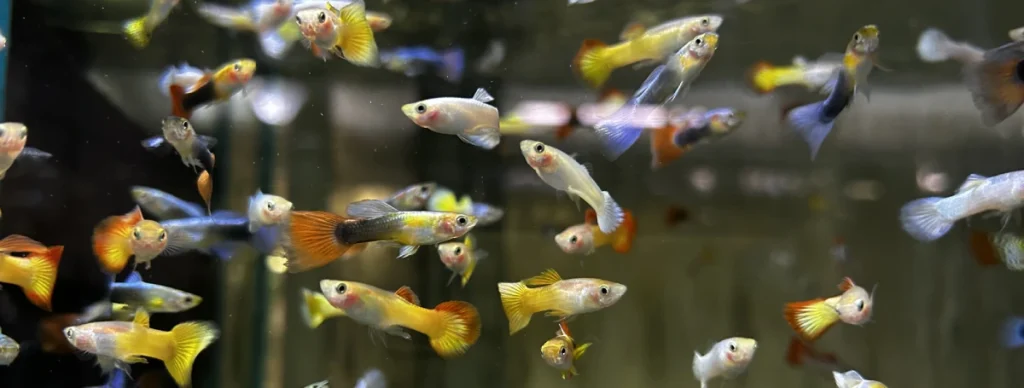
Look at a well-set-up guppy tank for more than a minute and you'll forget you're meant to be doing something else. Males cruise past each other with their tails fanned out, each one a stunning and distinctive colour - cobalt, flame, emerald, jet black. A female drifts into the hornwort, heavy with fry. A snail makes its unhurried way across the glass. Something small and silver darts between stems - a newly-hatched fry that wasn't there yesterday!
Guppies have a reputation for being the easiest fish in the world to look after. This is partly true - they're forgiving, hardy, and rarely a challenge. But there are major differences between guppies that are surviving and guppies that are thriving. Guppies have a sensitive social structure. They're not just fish - they're a community. And like any community, they need care.
When you set up a spacious, well-equipped guppy tank, you'll be creating a whole new world, which will reward you for years to come. Here are a few tips for getting it right.
Why the Setup Actually Matters
Guppies (Poecilia reticulata) have earned their beginner-friendly reputation. They tolerate a wider range of water conditions than most tropical species, eat nearly anything, and breed with minimal effort on their owner's part.
But “tolerant” isn't the same as “anything goes”. A guppy in poor conditions will survive - if survival means faded colours, clamped fins, and a fish hugging the bottom rather than dancing at the surface. The version that people fall in love with only happens when the environment is right.
Guppies have more than 300 recognised colour and tail varieties. They're livebearers - they give birth to swimming fry rather than laying eggs. They're also very social fish; a happy guppy always swims in groups. The males are showoffs: dramatically coloured and fin-heavy. Females are larger and plainer, but of course essential if you want fry.
Get the setup right, and we guarantee that your guppies will show you everything they've got.
How Much Space Do You Need?
Guppies are small - adults only reach about 5cm - which often leads beginners to underestimate how much tank space they need. The key is that guppies are schooling fish. They need a group, and groups need space.
40 litres is the realistic minimum for six to eight guppies. 60-80 litres is the sweet spot for 10 to 15 tankmates, with a real community and genuine activity. If you're thinking about breeding, 60 litres or more gives fry a better chance at survival in a tank where adults can't reach every corner.
Long tanks beat tall ones. Guppies swim at the middle and upper levels, and use horizontal space more than depth.
Rule of thumb: one guppy per 4-5 litres - and if you have males and females, account for fry in that number.
The Guppy Starter Kit - What You Need Before Day One
Buy your gear at least two weeks before the fish. This isn't excessive planning; it's what will allow your tank to cycle safely before anything living goes in.
If you want to learn more about cycling your tank - you can read our article about How to Cycle your Fish Tank the Right Way.
The Filter - Go Gentle
Guppies have long, flowing tails that look extraordinary in still water but become a liability in strong current. Guppy fry are tiny and easily pulled into filter intakes. Some tips for choosing the right filter:
- Sponge filters are the best option for a dedicated guppy or breeding tank. Gentle, fry-safe, and excellent biological filtration.
- Hang-on-back filters with a pre-filter sponge over the intake will protect fry and soften the flow.
- Filters with an adjustable flow rate enable you to dial back when needed.
Avoid a filter rated for a much larger tank running at full power. Consistent and gentle beats strong and turbulent every time. You can find aquarium filters at LiveFish suited to smaller community setups.
The Heater - Worth Fitting Year-Round
Guppies are tropical fish. Their ideal temperature range is 22°C-26°C. In most of Australia, summer ambient temperatures keep tanks comfortably warm without intervention. But winter is a different story - particularly in Melbourne, Canberra, and Tasmania.
Guppies can technically survive down to around 18°C, but below their preferred range they slow down, lose colour, and become vulnerable to disease. A heater set to 24°C will act as a backstop - invisible during summer, essential in the colder months.
Look for a small adjustable heater (a 25W or 50W unit is plenty for most guppy tanks, with a general rule of thumb being 1W for every litre of tank water) with a built-in thermostat. LiveFish carries aquarium heaters designed for exactly this kind of tropical setup.
The Lid
Guppies aren't compulsive jumpers the way Bettas are, but they can and do leap when startled. A lid or mesh cover costs very little and removes this risk entirely. It also slows evaporation, which matters in a heated tank.
Plants - Vital for the Perfect Guppy Tank
If there's one thing that separates a good guppy setup from a great one, it's plants. Dense planting isn't just aesthetic - it's functional, and for guppies it changes the entire social dynamic of the tank.
Why plants matter:
- Males will persistently chase and harass females. Dense planting gives females somewhere to retreat, breaking sightlines and reducing stress across the whole group.
- Fry instinctively hide in vegetation from the moment they're born. Without cover, they can be eaten almost immediately.
- Live plants absorb nitrates from the water, acting as a natural backup to your filter.
- Plus, of course, a planted guppy tank is one of the most beautiful things in the entire freshwater hobby!
The best plants for a guppy tank:
- Hornwort/Foxtail - fast-growing, thrives in almost any light, and creates the kind of dense coverage that fry can disappear into instantly. Can be floated or planted.
- Java Moss - low-maintenance, low-light, and another excellent refuge for newborn fry. Attach it to rocks or driftwood and let it spread.
- Anubias - hardy, slow-growing, and attaches to wood or rock rather than substrate. Nearly indestructible.
- Floating plants (Banana Lily or Water Lettuce) - guppies love the surface shade, and these plants are where fry naturally hide in the wild.
If you'd prefer artificial plants, only use silk - never hard plastic. Do the ‘nylon stocking test' before buying any decoration: run the stocking over the surface, and if it snags, it'll snag your guppies' fins too.
The Nitrogen Cycle - Never Skip This Step!
Your tank water can look perfectly clear and still be lethal to fish. That's the core lesson of the nitrogen cycle, and it's where a lot of beginners come unstuck.
A brand new tank has no beneficial bacteria - the microscopic organisms that process fish waste and keep ammonia levels safe. Building that bacterial colony takes two to three weeks, and the process is straightforward.
First, some important definitions:
- Ammonia is produced by fish waste and uneaten food. It's highly toxic to all fish.
- Nitrite is produced by bacteria converting ammonia, and is still toxic.
- Nitrate is produced by a second group of bacteria from nitrite. It's only harmful in high concentrations, and is removed through water changes.
How to cycle before your fish arrive: Add a small pinch of fish food to your empty, running, filtered tank every day for two to three weeks. The food will break down and produce ammonia, which feeds the bacterial colonies you need. Test the water with an aquarium test kit. When both Ammonia and Nitrite read 0ppm, the tank is ready.
Many beginners add guppies on day one because the water looks clean. Clear water and safe water are not the same thing. The extra two weeks is what separates a thriving tank from a frustrating cycle of sick fish.
If you want to learn more about cycling your tank - you can read our article about How to Cycle your Fish Tank the Right Way.
Choosing Your Guppies - and Building Their Community
This is the fun part. Guppies come in an extraordinary range of colours and tail shapes - Moscow Blues, Red Dragons, Cobra patterns, Dumbo ears, Lyretails, Speartails. You can keep guppies for years and never exhaust their variety.
Before picking your varieties, decide on your social setup:
The 1:2 ratio - one male to every two or three females - is the standard for mixed-sex tanks. It spreads male attention so that no single female is constantly pursued.
All-male tanks are increasingly popular. The colours are extraordinary, there's no population explosion, and males display constantly even without females. If you don't want to manage fry, this is a great option.
All-female tanks are peaceful and low-drama, but significantly less colourful.
When selecting your fish, look for males swimming upright and actively, with vivid colour and undamaged fins. Females should look well-bodied and alert. Browse LiveFish's guppy collection - there's a good chance you'll spend longer choosing than expected.
Tankmates that work well:
- Corydoras catfish - peaceful bottom-feeders that clean up what guppies miss. A classic pairing.
- Nerite Snails or Amano Shrimp - excellent algae cleaners; guppies completely ignore them.
- Rasboras - Harlequin Rasboras introduce dynamic, peaceful movement to the mid-tank.
- Endlers Livebearers - same care needs, but note: they will interbreed with guppies.
Tankmates to avoid:
- Bettas - male Bettas treat male guppies as rivals. The flowing tails trigger aggression. Do not mix.
- Tiger Barbs or Serpae Tetras - notorious fin-nippers. Guppy tails are irresistible to them.
- Large cichlids - guppies will be their lunch.
Feeding - Small Fish, Real Appetite
Guppies are omnivores and not fussy eaters. But a varied diet makes a visible difference - for brighter colours, better condition, and healthier fry.
Feed a high-quality flake or micro-pellet as the daily staple. Once or twice a week, treat them with frozen foods: baby brine shrimp, daphnia, or micro-worms. These are particularly good for conditioning females if you're planning to breed your guppies. Feed only what the fish consume in two or three minutes, twice a day. Ideally, fast them on one day each week.
If you have fry in the tank, they need fine food from day one - powdered fry food or finely crushed flake. They can't compete with adults for food, so either feed small amounts frequently throughout the day or move fry to a separate grow-out space.
You'll find guppy-appropriate foods in the LiveFish food collection, including frozen options that make a real difference to their colour and vitality.
The Part Nobody Warns You About - They Will Breed!
Guppies are nicknamed “Millionfish” for a good reason. A female can store sperm from a single mating and produce multiple batches of fry over several months - without any further contact with a male. If you have males and females, fry will appear. It is not a matter of ‘if'.
In a well-planted community tank, most fry are eaten naturally. This is the tank's own balance, and it keeps the population in check without any intervention from you. If you want to raise fry intentionally, a small breeding box suspended inside the main tank will keep them safe from adults in the early weeks.
If you'd rather avoid managing population altogether, an all-male tank solves the problem entirely.
Weekly Maintenance - Easier Than You Think
Once your tank is cycled and the fish are settled, keeping it healthy is pretty simple.
Weekly: Change 10-20% of the water using a gravel vacuum and replace it with fresh, dechlorinated tap water. A water conditioner removes chlorine from tap water instantly - always use it.
Monthly: Rinse your filter media in a bucket of old tank water, never under the tap. Chlorine kills the beneficial bacteria your tank depends upon.
Ongoing: Keep an eye on your fish. Guppies that are thriving are active, colourful, and swim close to the surface. A fish that's hiding, clamped, or listing should prompt a water test before anything else.
Quick Reference: Guppy Setup at a Glance
| Feature | Requirement | Why |
|---|---|---|
| Min Tank Size | 40-60 litres | Room for a social group |
| Temperature | 22°C-26°C | Active, colourful, healthy fish |
| Filter flow | Low or gentle | Fry-safe; protects flowing fins |
| Diet | Flake + frozen varieties | Vivid colour and vitality |
| Social setup | Groups: 1M : 2-3F ratio | Reduces stress and harassment |
| Plants | Dense: hornwort, java moss | Fry survival and female refuge |
Common Guppy Myths: Facts vs. Fiction
Myth: “Guppies don't need a heater in Australia.” Reality: In summer this is usually true; but in winter - especially in Melbourne, Canberra, or Tasmania - an unheated tank can drop well below 20°C. That's cool enough to suppress their immune system and trigger disease. A heater set to 24°C is cheap insurance.
Myth: “Guppies can live with Bettas.” Reality: Male Bettas register male guppies as rivals - those flowing tails trigger the same aggression response as another Betta. Some Bettas will also attack females. They are not compatible tankmates.
Myth: “Guppies breed so fast they're impossible to manage.” Reality: In a community tank with other fish, fry survival rates are low enough that the population stays manageable. Dense planting, a balanced community, and the occasional all-male setup are all practical solutions.
That tank you pictured at the start - males fanning their tails, fry ghosting through the hornwort, a passing snail minding its own business - is not complicated to build. It just needs the right foundation before the fish arrive. Set your tank up properly, and guppies will fill it with colour and life for years.
And they'll add more excitement to your life than you could possibly imagine.