


Black Walking Fish (10-12cm)
There aren't many aquarium animals quite as unusual as the Axolotl. Although commonly called a Walking Fish, an Axolotl is actually a fully aquatic salamander that retains its juvenile external gills throughout adulthood. This process, known as neoteny, gives the animal its unmistakable appearance and allows it to remain underwater throughout its life. The Black Axolotl is a particularly attractive colour form, with dark pigmentation across the body creating a strong contrast against the delicate branching gills on either side of the head.
-

-
 Black Axolotl 15cm$91.95
-
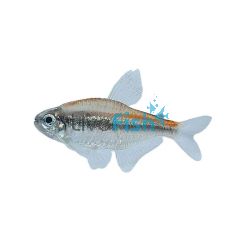 Chocolate Neon Tetra 3cm$28.83


Black Axolotl
There aren't many aquarium animals quite as unusual as the Axolotl. Although commonly called a Walking Fish, an Axolotl is actually a fully aquatic salamander that retains its juvenile external gills throughout adulthood. This process, known as neoteny, gives the animal its unmistakable appearance and allows it to remain underwater throughout its life. The Black Axolotl is a particularly attractive colour form, with dark pigmentation across the body creating a strong contrast against the delicate branching gills on either side of the head.
Black Axolotls develop a broad flattened head, rounded snout and elongated body supported by four short legs. Their colouration can range from charcoal grey to a rich velvety black, sometimes with subtle variations in pigmentation across the face and tail. The external gills extend from either side of the head like finely branched feathers, whilst the broad tail carries a soft fin that helps propel the animal through the water. Rather than constantly swimming, Axolotls spend much of their time slowly walking along the bottom before taking a sudden burst of movement when investigating food. Their dark colour looks particularly impressive over pale fine sand, although the aquarium should always be designed around safety rather than appearance alone.
Sexing Axolotls becomes easier once they reach sexual maturity. Males generally develop a more prominent cloacal swelling behind the rear legs, whilst females often have a broader body. During courtship the male deposits spermatophores which the female collects before later attaching individual eggs to plants and other aquarium surfaces. Axolotls also possess the remarkable ability to regenerate damaged limbs and certain other tissues, although this should never be mistaken for an ability to tolerate poor handling or unsafe tank mates.
Tank Recommendations for your Black Axolotl
Black Axolotls need a dedicated cool water aquarium with stable temperatures ideally around 16 to 18°C. A minimum of 100 litres with generous floor space is recommended for one adult, with a larger aquarium preferred as they approach 30 cm. Overheating is a serious concern and a chiller may be required during warmer months. Use fine sand for appropriately sized animals or a bare bottom, avoiding any gravel or stones small enough to be swallowed. Provide smooth caves, subdued lighting and gentle filtration without excessive current.
Suitable Tank Buddies
Axolotls are best kept in their own dedicated aquarium because fish and other animals can nip their external gills or become prey.
Usually Compatible
Another similarly sized Axolotl may be suitable in a spacious aquarium with careful feeding and observation, although keeping one alone is often the simplest option.
Sometimes Compatible
Some cool water snails may be tolerated, but there is still a risk of injury or ingestion and they are not generally needed in an Axolotl aquarium.
Rarely Compatible
Tropical fish, goldfish, aggressive fish, crayfish and small fish that can be swallowed should be avoided. Warm community aquariums are completely unsuitable.
Feeding your Black Axolotl
Axolotls are carnivorous and thrive on appropriately sized earthworms and quality sinking Axolotl pellets. Occasional suitable frozen foods can provide variety. Juveniles require more frequent feeding than adults, and any uneaten food should be removed promptly to protect water quality. Avoid feeder fish and food items that introduce a risk of choking or impaction.
| Scientific Name | Ambystoma mexicanum |
|---|---|
| Care Level | Moderate |
| Common Names | Black Axolotl, Mexican Axolotl |
| Diet | Carnivore |
| Fish Family | Ambystomatidae |
| Lifespan (years) | 15 |
| Max. Length (cm) | 30 |
| Min. Tank Volume (l) | 100 |
| Origin | Mexico, captive bred |
| Sociability | Aggressive |
| Venomous | No |
| Water Conditions | 14 to 20°C, ideally 16 to 18°C, pH 6.5 to 8.0 |
| Plant Safe | Yes |