


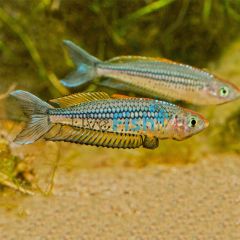
Wonga Creek Rainbow 5cm
Australia is home to some of the most spectacular freshwater rainbowfish in the world, and few groups demonstrate the importance of geographic locality quite like Melanotaenia trifasciata. Fish from different creeks and river systems can develop remarkably different colours despite belonging to the same species. The Wonga Creek Rainbow is a locality form of the Banded Rainbowfish from the Northern Territory, combining the powerful body shape and energetic schooling behaviour of the species with attractive blue, red, and darker colouration. Keeping the locality name attached to the fish is important because it helps preserve the identity of each naturally occurring form.
-

-

-

-

-
 Rhad - Bribie Island 3cm$19.53


Wonga Creek Rainbow
Australia is home to some of the most spectacular freshwater rainbowfish in the world, and few groups demonstrate the importance of geographic locality quite like Melanotaenia trifasciata. Fish from different creeks and river systems can develop remarkably different colours despite belonging to the same species. The Wonga Creek Rainbow is a locality form of the Banded Rainbowfish from the Northern Territory, combining the powerful body shape and energetic schooling behaviour of the species with attractive blue, red and darker colouration. Keeping the locality name attached to the fish is important because it helps preserve the identity of each naturally occurring form.
The Wonga Creek Rainbow develops an elongated body that becomes noticeably deeper as males mature. Dark blue and dusky black colouration can appear across the upper body, with warmer reddish tones and metallic blue highlights becoming visible through the flanks. The fins may develop striking red pigmentation, particularly in mature males displaying to one another. A darker lateral band and finer surrounding stripes give the species its characteristic banded appearance, although the intensity can change considerably with mood and lighting. Females generally remain slimmer and display more subdued colours. In a planted aquarium, a group of mature males can be especially impressive as they raise their fins and display side by side in the early morning.
Sexing Wonga Creek Rainbows becomes straightforward once they mature. Males generally grow deeper in the body and develop stronger colouration and more pronounced finnage, whilst females remain slimmer and less intensely coloured. Like other rainbowfish, they are egg scatterers, depositing small adhesive eggs amongst fine-leaved plants or spawning mops. Spawning may occur repeatedly when mature adults are well-conditioned, although the eggs and fry should be separated if a high survival rate is desired. Different locality strains should not be mixed for breeding because doing so would compromise their distinctive natural identity.
Tank Recommendations for Your Wonga Creek Rainbow
A minimum aquarium size of around 180 litres is recommended for a group of at least six Wonga Creek Rainbows. These are active swimmers and benefit from a long aquarium with open water in the centre and dense plants around the sides and rear. Moderate water movement, strong filtration and a secure lid are important. Stable water conditions and a varied diet will support the best development of male colouration, particularly once the fish reach maturity.
Suitable Tank Buddies
Wonga Creek Rainbows are active but generally peaceful, making them excellent residents for larger Australian and community aquariums.
Usually Compatible
Other peaceful rainbowfish kept for display rather than crossbreeding, larger tetras, Corydoras and Bristlenose Catfish with compatible water requirements.
Sometimes Compatible
Smaller cichlids and gouramis may coexist in larger aquariums, although territorial fish and slow feeders can be disturbed by the constant activity of rainbowfish.
Rarely Compatible
Large predatory cichlids, aggressive fin nippers and fish that require consistently very soft, acidic water should generally be avoided.
Feeding Your Wonga Creek Rainbow
Wonga Creek Rainbows are omnivorous and readily accept quality floating pellets and flakes. Frozen bloodworms, daphnia, brine shrimp and small insects provide excellent supplementary food. A varied diet containing both plant and animal ingredients encourages good growth and helps mature males develop their strongest blue and red colouration.
| Scientific Name | Melanotaenia trifasciata |
|---|---|
| Care Level | Easy |
| Common Names | Wonga Creek Rainbow, Banded Rainbowfish |
| Diet | Omnivore |
| Fish Family | Melanotaeniidae |
| Lifespan (years) | 5 |
| Max. Length (cm) | 12 |
| Min. Tank Volume (l) | 180 |
| Origin | Wonga Creek, Northern Territory, Australia |
| Sociability | Peaceful |
| Venomous | No |
| Water Conditions | 23 to 28°C, pH 6.5 to 8.0 |
| Plant Safe | Yes |