


Malawi Barracuda 5cm
There aren't many African cichlids that look or behave anything like the Malawi Barracuda. Whilst most Lake Malawi aquariums are dominated by deep-bodied Mbuna, Peacocks and Haps, Rhamphochromis have evolved into streamlined open-water predators built specifically for chasing other fish. Rhamphochromis macrophthalmus is a fantastic example of this completely different lifestyle, combining a long, torpedo-shaped body, large predatory mouth and incredible swimming ability. This is a fish that can make even a large Malawi aquarium suddenly feel considerably smaller.
-
-
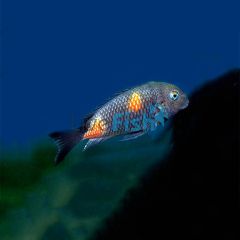 Tropheus Cherry Spot 3cm$49.64
-
-
-
-


Malawi Barracuda
There aren't many African cichlids that look or behave anything like the Malawi Barracuda. Whilst most Lake Malawi aquariums are dominated by deep-bodied Mbuna, Peacocks and Haps, Rhamphochromis have evolved into streamlined open-water predators built specifically for chasing other fish. Rhamphochromis macrophthalmus is a fantastic example of this completely different lifestyle, combining a long, torpedo-shaped body, large predatory mouth and incredible swimming ability. This is a fish that can make even a large Malawi aquarium suddenly feel considerably smaller.
The Malawi Barracuda develops an elongated silver to pale blue body with a noticeably pointed head and large mouth. Individual scales can reflect metallic blue, green and silver depending on the aquarium lighting, whilst mature males can develop considerably stronger blue colouration through the body and fins. Darker markings may become visible along the flanks, particularly in younger or subordinate individuals. Unlike the compact movement of rock-dwelling Malawi cichlids, the body of the Malawi Barracuda is built for sustained open-water swimming. They cruise through the aquarium with relatively little effort before producing sudden bursts of speed when feeding or chasing another fish. Their combination of silver colour, streamlined proportions and obvious predatory build is exactly where the "Malawi Barracuda" name starts making sense.
Sexing Malawi Barracuda becomes easier with maturity, as males generally develop stronger colouration whilst females retain more subdued silver tones. Like many Lake Malawi cichlids, Malawi Barracuda are maternal mouthbrooders. Following spawning, the female collects the fertilised eggs into her mouth and carries them throughout incubation before releasing fully developed fry. Their eventual size means successful breeding requires considerably more space than most commonly maintained Malawi cichlids.
Tank Recommendations for Your Malawi Barracuda
This is absolutely not a standard 120 cm Malawi cichlid. Malawi Barracuda are large, extremely active open-water predators and require an aquarium designed around swimming length rather than elaborate rockwork. An aquarium of at least 600 litres is recommended for mature fish, with larger systems strongly preferred.
The aquarium should contain enormous amounts of open swimming space, with rockwork concentrated towards the ends or back rather than filling the centre. Strong filtration, excellent oxygenation and stable, hard, alkaline water are essential. A secure lid is also recommended due to their speed and ability to launch themselves from the aquarium when startled.
Suitable Tank Buddies
Malawi Barracuda are predatory cichlids, and tank mates need to be selected primarily around size, swimming ability and compatibility with Lake Malawi water conditions.
Usually Compatible
Large Malawi Haps and other robust open-water cichlids that are far too large to be swallowed can make suitable companions in genuinely large aquariums.
Sometimes Compatible
Large Frontosa, Nimbochromis and similarly substantial African cichlids may coexist under some circumstances, although differences in natural habitat, temperament and feeding behaviour mean the aquarium needs to be planned carefully.
Rarely Compatible
Mbuna juveniles, small Peacocks, tetras, guppies and virtually any fish small enough to fit inside the mouth should be considered potential prey. Slow-moving or delicate fish should also be avoided around such a powerful open-water predator.
Feeding Your Malawi Barracuda
Malawi Barracuda are naturally predatory and require a protein-rich diet. Quality carnivorous cichlid pellets can form the staple diet and should be supplemented with prawns, krill, mussels and other suitable frozen foods. Feeder fish aren't required and are generally best avoided, as prepared and frozen foods provide a much more controlled and nutritionally balanced diet.
| Scientific Name | Rhamphochromis macrophthalmus |
|---|---|
| Care Level | Moderate |
| Common Names | Black Balloon Ramirezi, Black Balloon Ram, Balloon German Blue Ram |
| Diet | Omnivore |
| Fish Family | Cichlidae |
| Lifespan (years) | 4 |
| Max. Length (cm) | 5 |
| Min. Tank Volume (l) | 75 |
| Origin | South America |
| Sociability | Peaceful |
| Venomous | No |
| Water Conditions | 26-30° C, pH 5.5-7.5 |