


Butterflyfish Finger Print - Medium
Finger Print Butterflyfish are graceful swimmers and a sight to behold in any aquarium. They are sure to become one of the stars of your tank.
-
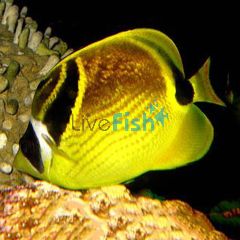 Raccoon Butterflyfish - Medium$109.89


The Finger Print Butterflyfish can reach a maximum length of 12 cm (4.7 in). The body is powder blue with a pattern of narrow, white chevron bars. The head and front of the body are a bright red-orange colour. The back of the dorsal and caudal fins are both black.
Their bodies are palm-shaped, with a protruding snout that varies in length and is tipped with their small mouths. This pancake body shape and apical mouth arrangement are ideal for zooming in and out of the shallow coral reef habitats where the majority of species live.
Butterflyfishes are members of the Chaetodontidae family ("Key-toe-don-tah-dee"), which means "bristle-tooth," a telling allusion to many of these fishes feeding problems.
There are approximately 120 species of Butterflyfish in total. They are most often found in the Pacific, Indian, and Atlantic oceans also the Red sea. Their primary habitat is coral reefs.
Tank Recommendations for Fingerprint Butterflyfish
These fish are analogous to a "canary in a coal mine." They will be the first to show signs when the water quality is poor or deteriorating. A high, consistent pH (8.2, 8.3) and little to no detectable organics are required for good water quality. An efficient skimmer is required for these purposes for a closed marine system. We recommend using coarser coral sand for the substrate to increase pH buffering capacity and to ease the cleaning up of any meaty 'leftovers.' External pH 'raisers' can also be used.
Unfortunately, butterflyfishes are highly susceptible to crypt, velvet, other common protozoal complaints (e.g., Glugea), bacterial infections, and "gill fluke" problems. They are frequently the first fish(es) to show signs of this in a tank. Fortunately, if caught in time, these can be quickly cured using traditional remedies (copper, malachite green treatments). Because some species are copper sensitive, use a test kit to avoid over-treatment.
There should be areas of the tank with a current as this will aid producing a high dissolved oxygen concentration and the Butterflyfish appreciate the moving water. The natural environment of most Butterflyfish is the rough and tumble of coral shallows where the pH is high, the water is clean, the current is brisk, and the temperature is high in this bright nook and cranny world. These are the conditions that you are looking to recreate in your aquarium setup.
Suitable Tank Buddies
The majority of Butterflyfish make excellent tankmates with other fish, however most are likely to fight with their own species unless it is a mated pair. If planning to keep multiple Butterflyfish together to avoid fights with their own or similar kind ensure they are in a large system with plenty of cover for hiding.
Usually Compatible
Butterflyfish can coexist with non-aggressive fish such as Angelfish, both dwarf and large, Frogfish, Anthias Basslets, Pseudochromis, Batfish, Blennies, Boxfish, Cardinals Clownfish, Dragonettes, Goatfish, Gobies, Grunts, Hawkfish Hogfish, Lionfish, Parrotfish and Pufferfish.
Sometime Compatible
If Butterflyfish are housed with Crustaceans, Damselfish, Eels, Fancy Damselfish, Filefish, Invertebrates, Rays, Scorpionfish, Squirrelfish, Tangs, Triggerfish or finally Wrasses there may be a conflict.
Rarely Compatible
More aggressive fish, such as Groupers and Sharks, will harass or eat your Butterflyfish. Seahorses and Pipefish are also not recommended as they will compete for the same food sources. As the Butterflyfish will be too quick, this will mean your Seahorses and Pipefish may starve.
Feeding your Fingerprint Butterflyfish
Butterflyfishes have very fine hair-like teeth that allow them to pick out small organisms that most other fish are unable to eat.
They primarily feed on coral polyps, feather-duster tentacles, and Christmas tree worms. Butterflyfishes must be able to hover motionless while picking at the coral and dart quickly over short distances to catch the worm before it retracts, as all of these food sources zap back into their shells. They accomplish this by utilising their Pectoral fins as oars to brake, sprint, turn, and even reverse.
All Butterflyfish species can be picky eaters, especially when first introduced. It cannot be overstated how important it is to find an adequate, sustainable food mix as soon as possible and to offer it frequently. For newcomers, live brine shrimp is a good place to start, as are various types of worms and crustaceans available in the trade, both live and frozen. Other meaty foods, such as squid, minced clams, and prepared blends, should be served in small amounts and removed uneaten as they will quickly foul water.
If a fish goes on a feeding strike,' but the rest of the system is fine (showing a problem other than water quality), try any one of the following:
- 1) Place a fresh clam on the bottom, opened up.
- 2) To prevent escape, place live white, tubificid, or grindal worms in a tiny dish.
- 3) To boost appetite, Chlupaty (1978) recommends temporarily reducing the specific gravity for a few days (1.025 down to 1.018).
- 4) Because marine fish "drink like fish," you should provide vitamins to their water (and/or food); some vitamins have been shown to improve eating.
| Scientific Name | Chaetodon Larvatus |
|---|---|
| Care Level | Moderate |
| Common Names | Blue Chevron Butterflyfish, Brownface Butterflyfish, Coralfish, Larvatus Butterflyfish, Masked Butterflyfish, Maskface Hooded Butterflyfish, Orangeface Butterflyfish, Orange-faced Butterflyfish, Orangehead Butterflyfish, Redhead Butterflyfish, Red Sea But |
| Diet | Carnivore |
| Fish Family | Chaetodontidae |
| Lifespan (years) | 5 |
| Max. Length (cm) | 12 |
| Min. Tank Volume (l) | 300 |
| Origin | East Indian Ocean, The Red Sea |
| Reef Safe | No |
| Sociability | Peaceful |
| Venomous | No |
| Water Conditions | 75ºF -82ºF (25ºC - 28ºC) pH (8.2, 8.3) |